Provence Golf Course
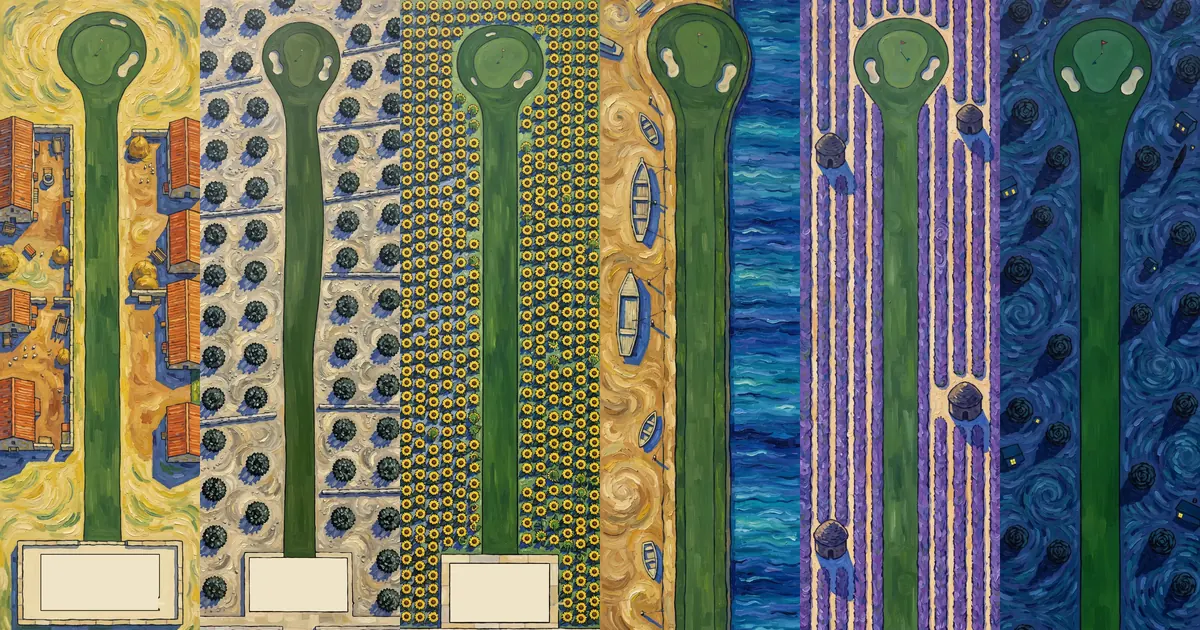
Six of the eighteen holes of the Provence course, seen from above.
A par-72 course where every hole is a small painting. The pictures are new, made for this game, and painted in the thick, swirling manner people know from Vincent van Gogh's years in Provence.
How it is painted
This course is not a portrait of one place. It is a way of painting. The hole pictures use bold colour and thick, visible brushwork; fields and skies turn in swirls; yellow is set against blue and orange against violet. That is the manner associated with Vincent van Gogh, whose later work is known for its expressive brushwork and its use of complementary colours such as blue and orange.
None of the pictures is a copy of a painting. Each hole is a new image, seen from straight above, a viewpoint Van Gogh did not paint from. Only the manner is borrowed. The subjects come from the two years he spent in Provence, in the south-east of France: he moved to Arles in February 1888, and from May 1889 to May 1890 he lived at the asylum of Saint-Paul in Saint-Rémy. Several hole names point to things he painted there. Hole 3, the drawbridge, recalls the Langlois Bridge near Arles, which he painted in the spring of 1888, in one version with women washing linen on the bank. Hole 4 is sunflowers, hole 5 the Rhône, hole 8 a vineyard like the one in The Red Vineyard of November 1888. Hole 17, a café square at night, recalls Café Terrace at Night, painted in Arles in September 1888 and his first picture with a starry sky. Wheat fields, olive groves, a quarry and the Alpilles hills belong to his year at Saint-Rémy, and the last hole takes its name from The Starry Night of 1889.
The other holes - lavender, a village, an avenue of trees, a reservoir, chestnut trees - use scenery of the Provençal countryside in general and are not tied to any one painting.
The 18-hole journey
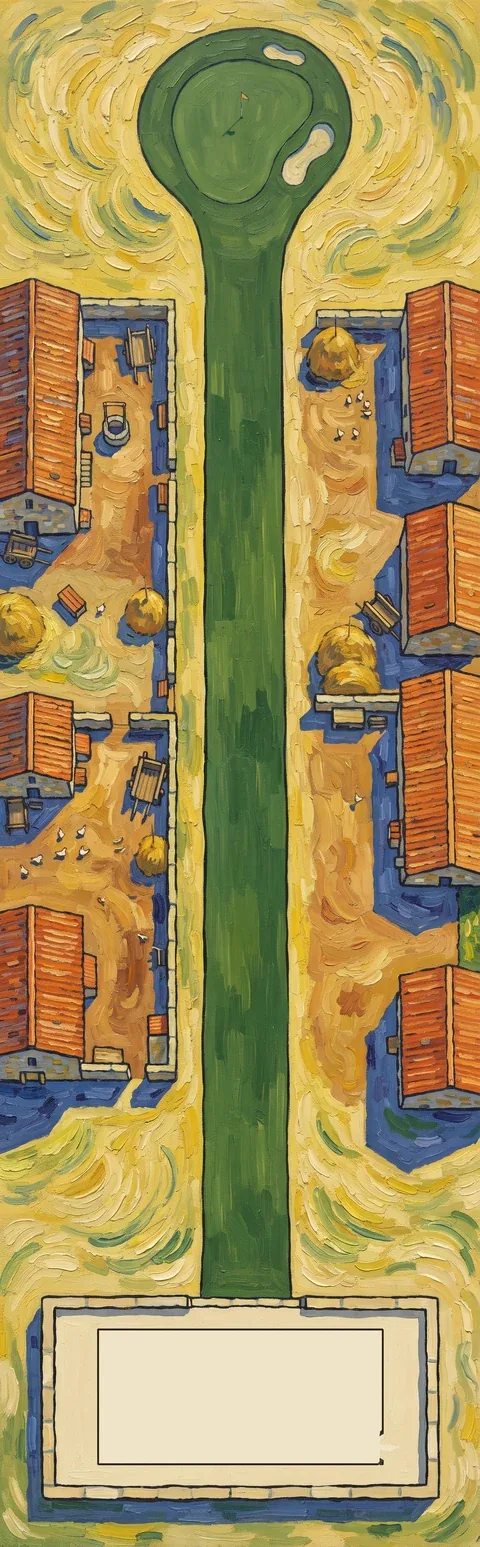 Hole 1 · Wheat FieldPar 4 · 300 m (328 yd)
Swirling yellow wheat on both sides. Farm buildings with orange roofs and round haystacks stand close to the fairway.
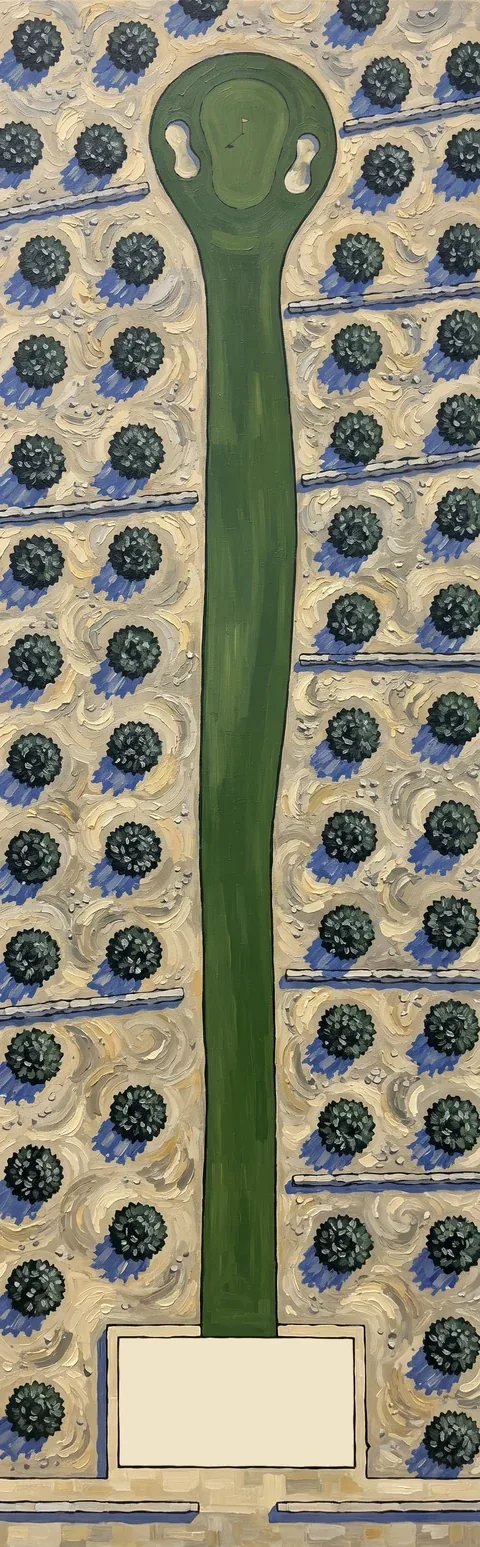 Hole 2 · Olive GrovePar 4 · 295 m (323 yd)
Round, dark olive trees in rows on pale ground, each with a blue shadow.
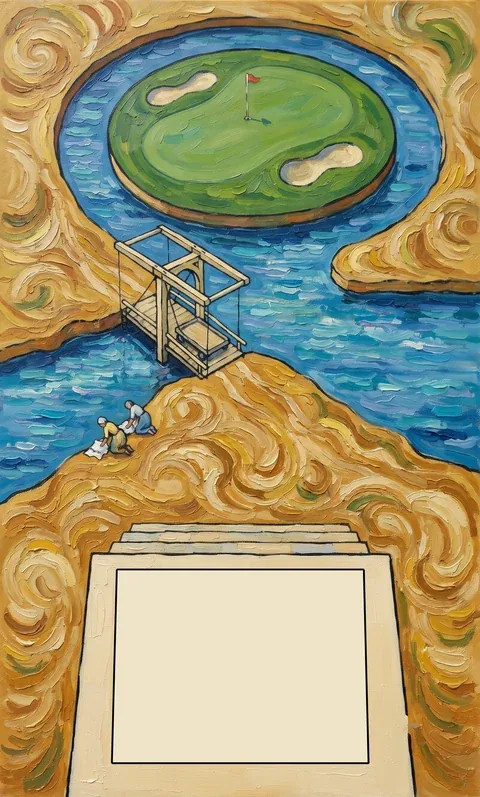 Hole 3 · DrawbridgePar 3 · 128 m (140 yd)
The green is an island in blue water. A wooden drawbridge crosses to it, and two figures sit on the near bank.
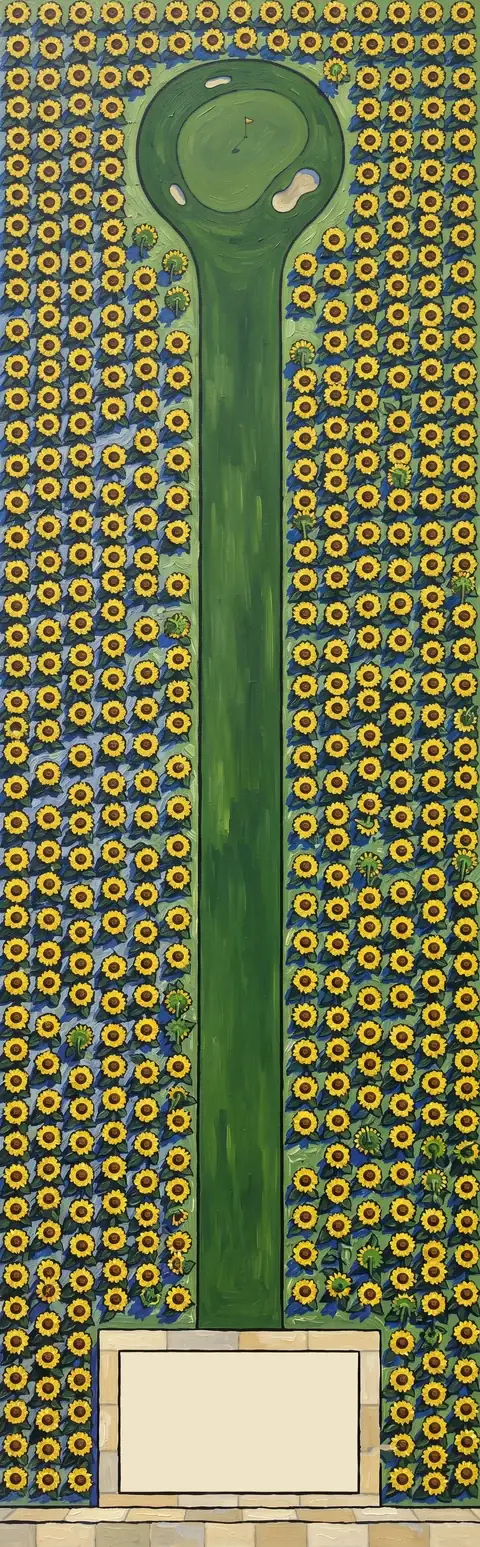 Hole 4 · SunflowersPar 4 · 304 m (332 yd)
Sunflowers from edge to edge, hundreds of yellow heads facing up.
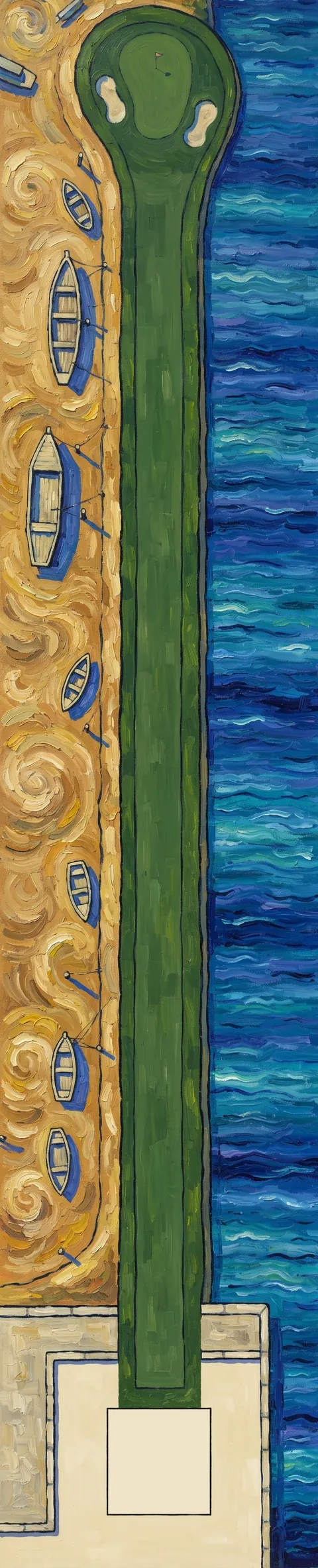 Hole 5 · The RhônePar 5 · 498 m (545 yd)
A deep-blue river runs down the whole right side. Small boats are drawn up on the sandy bank to the left.
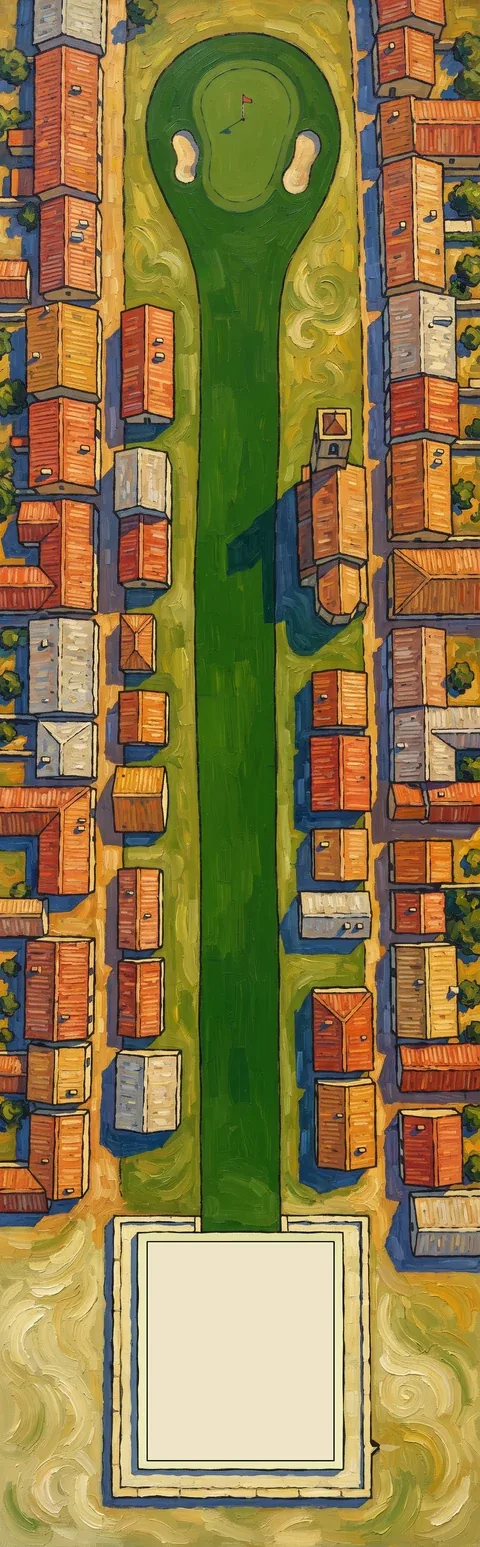 Hole 6 · FarmhousesPar 4 · 287 m (314 yd)
Orange-roofed houses line both sides of the fairway, with a small tower among them.
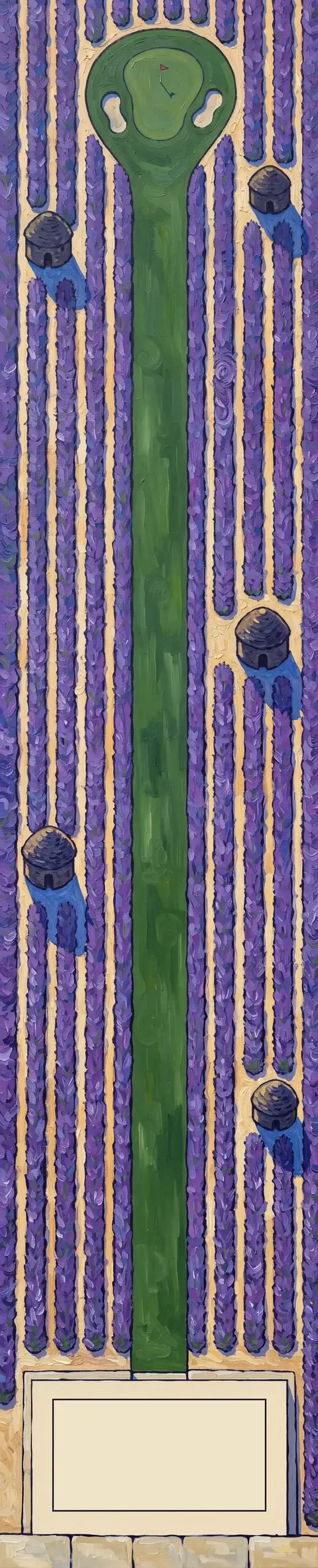 Hole 7 · LavenderPar 5 · 482 m (527 yd)
Purple rows of lavender run the length of the hole. Four round stone huts stand among them.
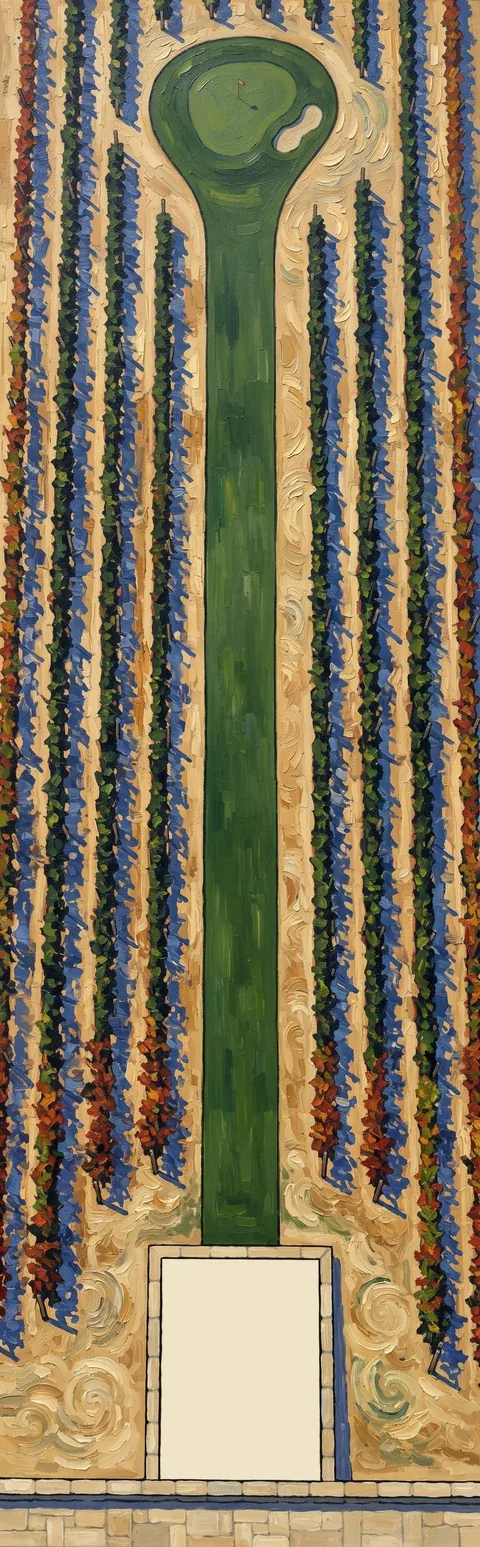 Hole 8 · VineyardPar 4 · 295 m (323 yd)
Vines in long rows, their leaves turned red and green.
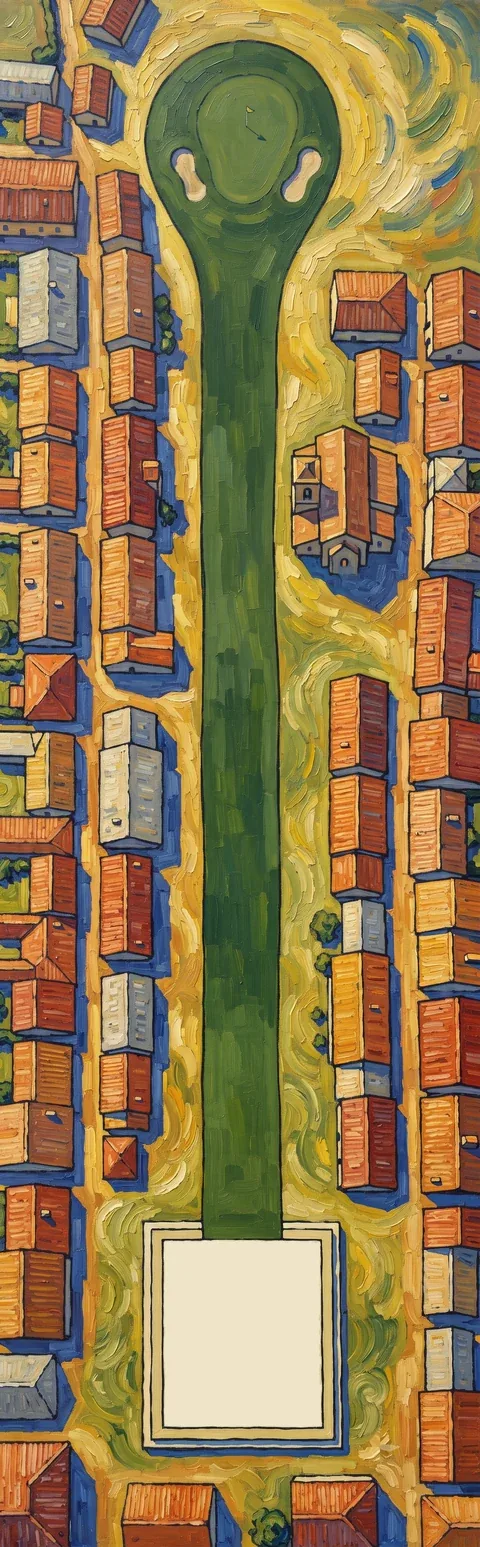 Hole 9 · VillagePar 4 · 278 m (304 yd)
A village packed tight on both sides: orange and grey roofs, and a church on the right.
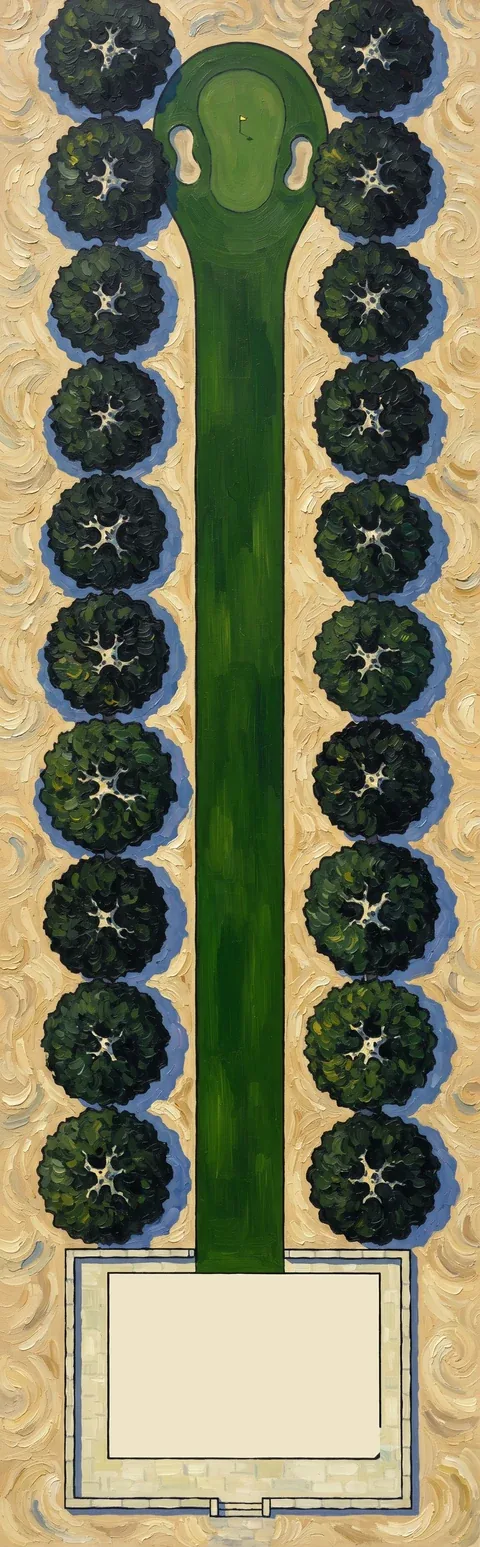 Hole 10 · Avenue of TreesPar 4 · 307 m (336 yd)
Two rows of big round trees stand along the fairway like a lined road.
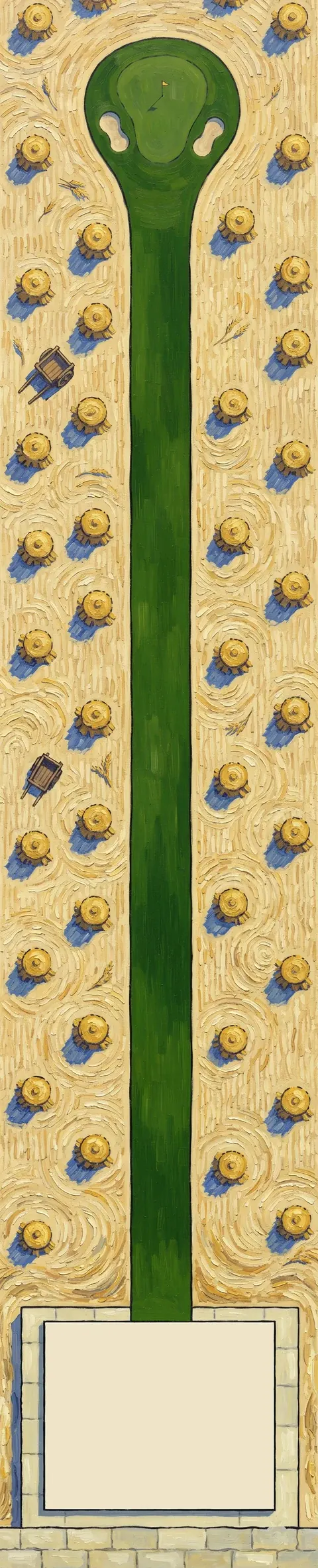 Hole 11 · SheavesPar 5 · 461 m (504 yd)
A pale cut field dotted with rows of yellow sheaves. Two carts stand on the left.
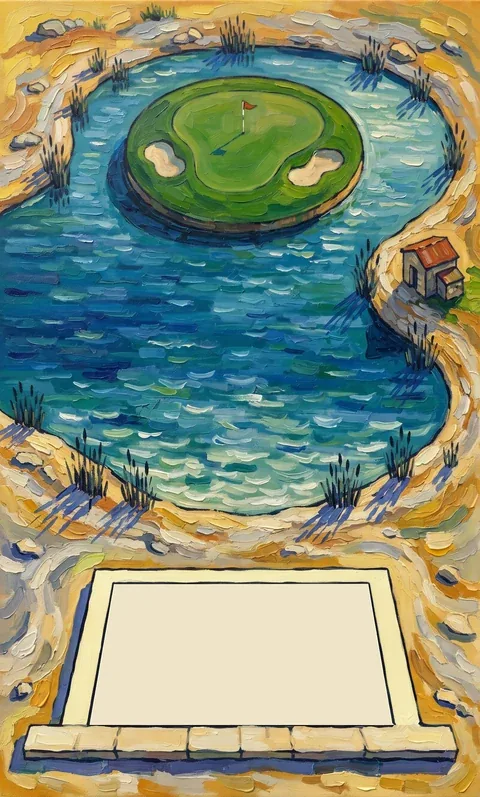 Hole 12 · ReservoirPar 3 · 120 m (131 yd)
The green is an island in a blue pond. Reeds grow at the edge and a small house sits on the bank.
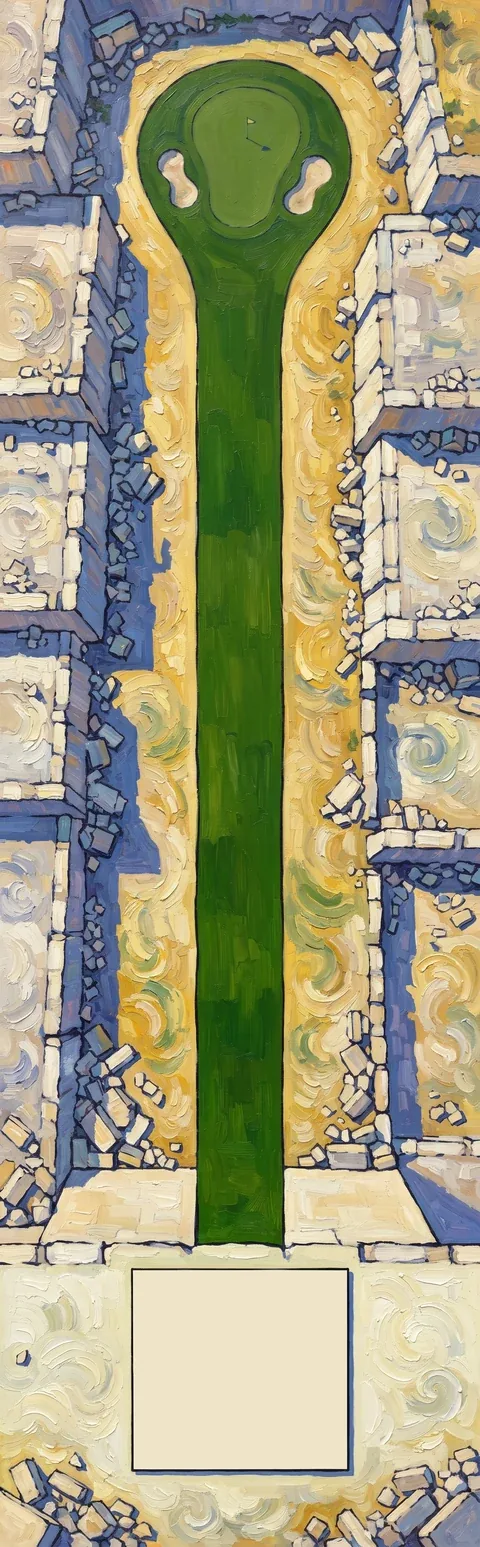 Hole 13 · QuarryPar 4 · 284 m (311 yd)
Blocks and steps of cut pale stone on both sides.
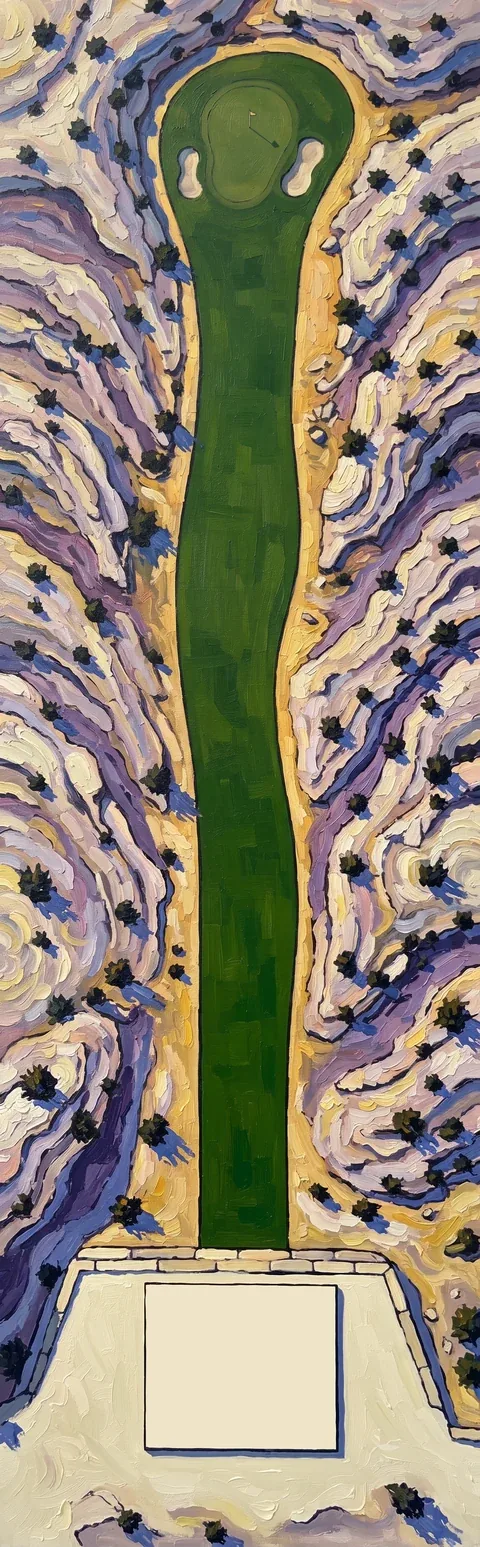 Hole 14 · AlpillesPar 4 · 294 m (322 yd)
Lilac and white ridges of rock swirl around the fairway, with small dark trees scattered on them.
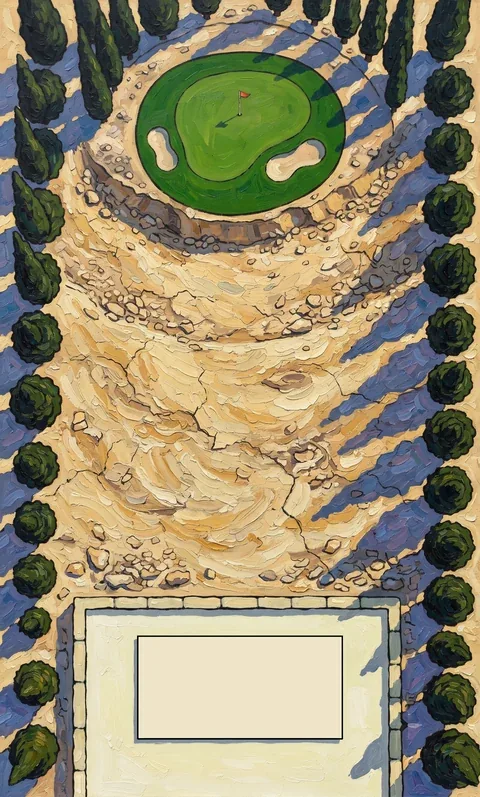 Hole 15 · Stony RavinePar 3 · 131 m (143 yd)
A bowl of pale, cracked stones with the green at the top. A line of dark cypress-like trees stands on each side.
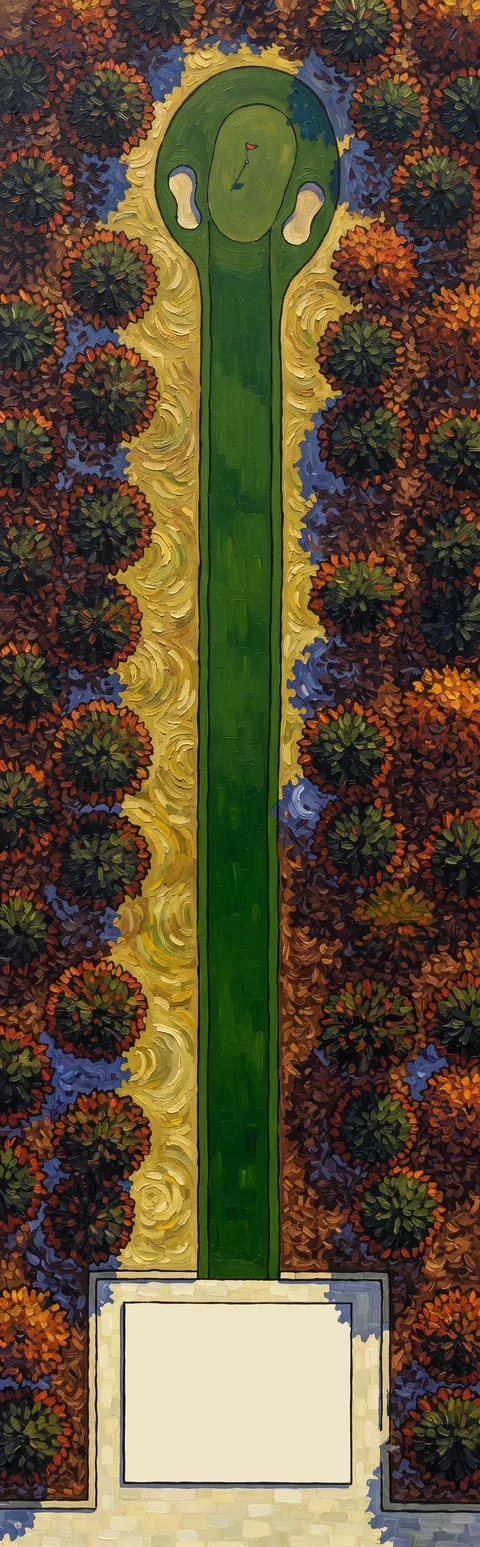 Hole 16 · Chestnut TreesPar 4 · 305 m (334 yd)
Trees in autumn orange and dark green crowd both sides.
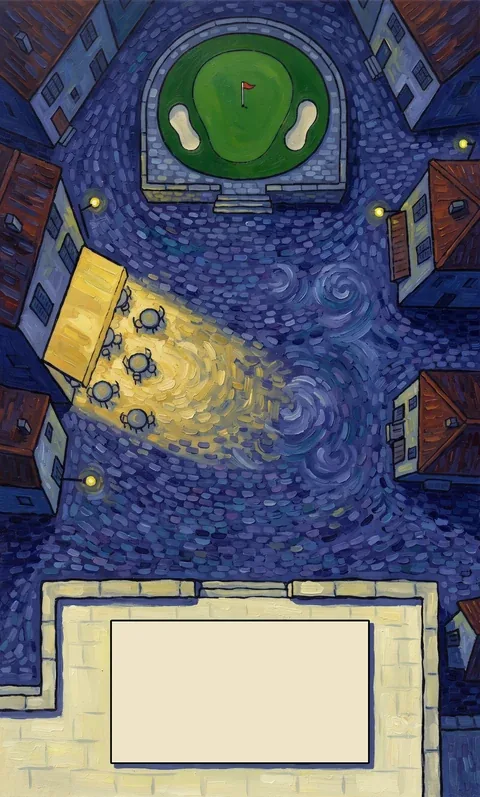 Hole 17 · CaféPar 3 · 139 m (152 yd)
A cobbled square at night. Yellow light spills from a café awning over round tables, and houses stand on both sides.
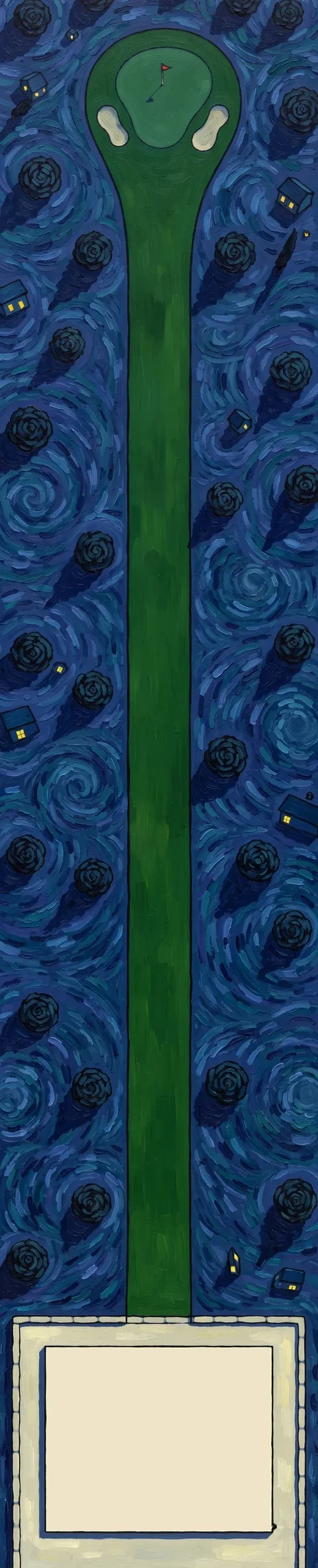 Hole 18 · Starry NightPar 5 · 470 m (514 yd)
Deep-blue swirls cover the ground. Dark trees and small houses with lit windows are scattered across it.
Hole notes describe what is drawn in each picture. Par and distances are the game's own course data.
How to play it
Par 72 over 5,378 m (about 5,883 yd): four par 3s, ten par 4s and four par 5s. It is a short course. No par 4 is longer than 307 m, and the par 3s run from 120 m (hole 12) to 139 m (hole 17).
The four par 5s are where the length is: holes 5 and 7 (498 m and 482 m) on the front nine, holes 11 and 18 (461 m and 470 m) on the back. All four are drawn as one straight line from tee to green.
In the course data this course has no water hazard and no bunker; the ponds on holes 3 and 12 and the sand shapes painted beside each green are part of the picture. What is left is distance control: the fairways are narrow strips, and most greens sit in a round clearing only a little wider than the fairway.
Sources: Vincent van Gogh · Langlois Bridge at Arles · The Red Vineyard · Caf%C3%A9 Terrace at Night · Saint-Paul Asylum, Saint-R%C3%A9my (Van Gogh series) · Provence