About haru: a Korean daily assistant and how it works
Haru — your personal almanac. Fortune, food, health and schedule, written for your birth chart.
See it for your chart → Open Haruharu (Korean for "one day") is a Korean-language daily assistant that keeps your plans, suggests a home-cooked dish and reads the day through the Four Pillars. Here is what each tab does, how the pillars are computed, and what the app keeps.
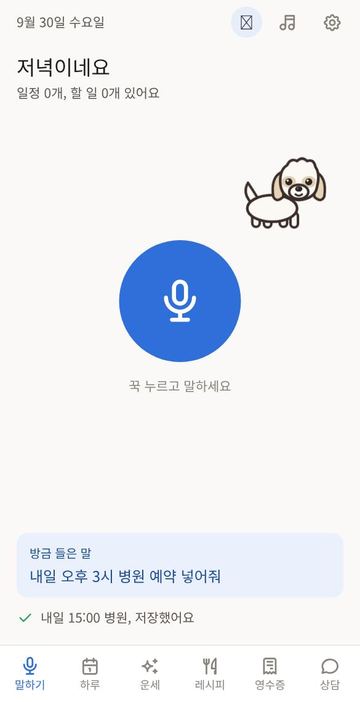
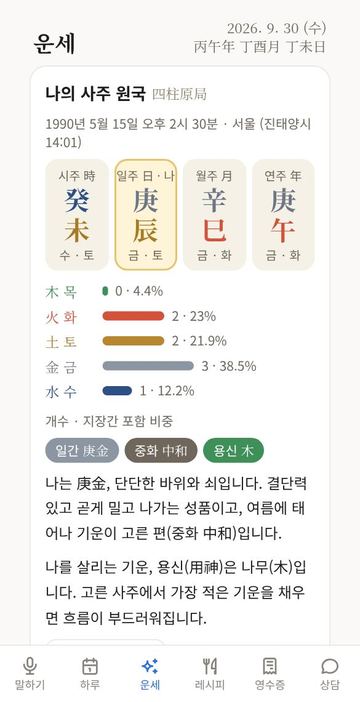
What haru does
haru runs in the web browser at webgametube.com. Its screens and written readings are in Korean, and the reading features appear only on the Korean screen outside WeChat. The counsel tab can also answer in English, Chinese, Japanese and Vietnamese.
| Tab | What it does |
|---|---|
| Speak (말하기) | Say or type a sentence; an AI model files it as a plan, a to-do or a memo and answers. Voice uses the browser's own recognition, or the server when the browser has none. |
| Day (하루) | Today's plans on a timeline, a short hint beside up to two timed plans (a meal, exercise, a meeting), and a folded memory panel. |
| Today reading (운세) | Your four pillars and five elements, day stem, strength and useful element; today's pillars and how they meet yours; the trigram of the day; notes on work, money, people and body; everyday eating, rest and movement tips. |
| Recipes (레시피) | Four dishes a day from a book of 17 Korean home recipes, each ingredient with its element and reason. Servings 1 to 8, save, or add to the shopping list. |
| Receipts (영수증) | Photograph a receipt; Tencent Cloud text recognition and a Zhipu AI image model read the store, date, total and items, then the photo is deleted. Food items go to a fridge list. |
| Counsel (상담) | Chat about the day, your chart, meals and habits, by text or voice, with answers read aloud and a hands-free mode. |
How the pillars are computed
Every pillar and number is worked out by code, not by an AI model. You enter a birth date (solar, or lunar with a leap-month box), a clock time or 'I don't know the time', one of 44 cities, and a rule for births between 23:00 and 24:00. Years 1900 to 2100 are accepted.
The code then counts the five elements, hidden stems included (the month branch counts double, as the season), judges the day stem's strength, picks a useful element by season and balance rules, and notes whether the chart leans hot or cold. An AI model rewrites these facts into friendly Korean; if its text breaks the rules (frightening words, certainty, medical or investment words), the plain sentence built by code is shown instead.
- Clock time becomes universal time using the city's time-zone history, summer time included.
- True solar time = universal time + longitude / 15 hours + the equation of time. Day and hour are read from it.
- The year pillar turns at the actual instant of 立春 (lichun, sun at 315°), not on 1 January or lunar new year.
- The month pillar turns at the 12 jie terms, every 30° from 315°; its stem follows the five-tiger rule (五虎遁).
- The day pillar comes from the continuous sixty-day count; the hour stem from the five-rat rule (五鼠遁).
- Late rat hour: the default 'midnight' rule keeps the date and gives the 子 hour the next day's stem; the '23:00' option starts the day at 23:00. The hour pillar is the same either way.
- Time unknown: six characters, no hour pillar; noon is used for year and month.
- Lunar dates use computed new moons and principal terms in Korean standard time (UTC+9); month 11 holds the winter solstice, and in a thirteen-month year the first month without a principal term is the leap month.
| Choice | Input | True solar time | Year · Month · Day · Hour |
|---|---|---|---|
| City and summer time | Seoul 1988-07-01 13:10 | 11:34 (−96 min) | 戊辰 戊午 丁巳 丙午 |
| Midnight rule (default) | Seoul 2000-01-01 23:40 | 23:04 | 己卯 丙子 戊午 甲子 |
| 23:00 rule | Seoul 2000-01-01 23:40 | 23:04 | 己卯 丙子 己未 甲子 |
| Time unknown | Seoul 1975-10-03 | noon used | 乙卯 乙酉 壬午 — |
| Lunar date | Lunar 1970-08-15 10:00 Seoul (solar 09-15) | 09:32 | 庚戌 乙酉 戊戌 丁巳 |
What a reading is, and what it is not
A reading shows how the yin-yang and five-element tradition reads your chart and the day. Each reading screen carries the app's note that it is a traditional interpretation, not medical diagnosis or advice. It is also not financial or investment advice and not a prediction. The two to five stars describe the day's mood in the tradition's terms, not a score of you, and the food and rest tips are ordinary habits.
In counsel, haru is told never to decide money, health or big life choices by the chart. Questions about medicine or pain end with a suggestion to see a doctor or pharmacist. If a message speaks of self-harm, the AI is not used: a fixed reply gives helplines (in Korea 109, or 112 and 119 in an emergency).
Privacy
No sign-up is needed. As a guest, all your haru records - birth date and chart, plans, to-dos, memos, memories, saved recipes, fridge and shopping lists, receipts, counsel and dream chats - stay only on this phone, in the browser's storage (IndexedDB). The server keeps none of them, and the chart and today's card are worked out in the browser.
Optional Google sign-in (Korean page) keeps your records on the server so they follow you to a new phone, until you ask us to delete them. We keep a hashed id made from your Google account id and your first name; Google's token check confirms the sign-in, and no email is stored. After signing in, the page asks whether to move this phone's guest records into the account.
- One random cookie, gv (kept 1 year, HttpOnly, Secure), remains as a visitor number the server uses for request limits and to recognise your visit; it carries no records.
- AI features (speech, sorting a sentence, receipt photos, the daily reading, recipe suggestions, counsel and dreams) send only what that request needs: the sentence, the photo, birth details or the last few messages. The server passes it on, returns the answer and keeps nothing; its logs note only that a request happened and how long it took.
- Speech and receipt text go to Tencent Cloud; text and receipt photos go to Zhipu AI in China. The browser's own speech recognition may send audio to the browser maker (Chrome, for example, to Google).
- Clearing site data or changing phones loses guest records. Use '내 기록 내보내기 / 불러오기' (one file) in the profile sheet, or sign in. Safari on iPhone may clear a site's storage after 7 days unused; the page shows a notice once.
- Schedule alerts come from the server, so they work only after sign-in.
- Guest records from before this change move to your phone on your next visit and are then deleted on the server. If you do not return within 90 days they are deleted; a deletion backup is kept 7 days, then removed.
- Notes like an allergy or a food you avoid are used to swap or drop recipe ingredients.
- Google Fonts and jsDelivr serve the font and icons. To have signed-in data deleted, ask at webgametube.com/contact/.
Questions
Do I need an account?
No. As a guest your records stay in this phone's browser. On the Korean page, optional Google sign-in keeps them on the server so they follow you to a new phone.
Why does the birth city matter?
Day and hour are read from true solar time, which depends on longitude and time zone. In Seoul's 1988 summer time, a 13:10 clock became 11:34.
What if I don't know my birth time?
haru reads six characters with no hour pillar.
Can haru tell my future?
No. It shows how a tradition reads the day; it is not a prediction or advice.
How do I delete my data?
Guest records live only on your phone: clearing the site's data removes them. For a signed-in account, ask at webgametube.com/contact/.